Cognitive Engineering
Your Brain Was Never Built for This
A billion pesos sounds enormous. So does ten billion. The tragedy is they feel roughly the same — and that gap in human cognition has real consequences far beyond what you'd expect.

Somewhere in the news cycle, a number appeared. ₱13 billion. Flood control infrastructure. Ghost projects, inflated contracts, the usual architecture of impunity. Then the figure was revised to ₱42 billion. Then ₱118 billion.
People were outraged at each, as they should have been. But here's the part nobody talks about: most of us, including engineers who work with large numbers professionally, didn't feel the difference between any of them. ₱13B and ₱118B both registered as "big." We moved on.
That's not cynicism. That's neuroscience, and it's one of the most underappreciated failure modes in how humans reason about systems at scale.
We Think in Logarithms, Not in Lines
Humans did not evolve to count past a few hundred. For most of our species' history, the largest meaningful quantities were things like the number of people in a tribe, or animals in a herd.
Our brains optimized for that world. The optimization strategy was compression: we perceive magnitude logarithmically.
This is documented as the Weber-Fechner Law: our ability to distinguish between two quantities depends not on their absolute difference, but on their ratio. The jump from 1 to 10 feels as significant as the jump from 10 to 100, or from 100 to 1,000. Each step feels like the same size even though they grow by a factor of ten each time.
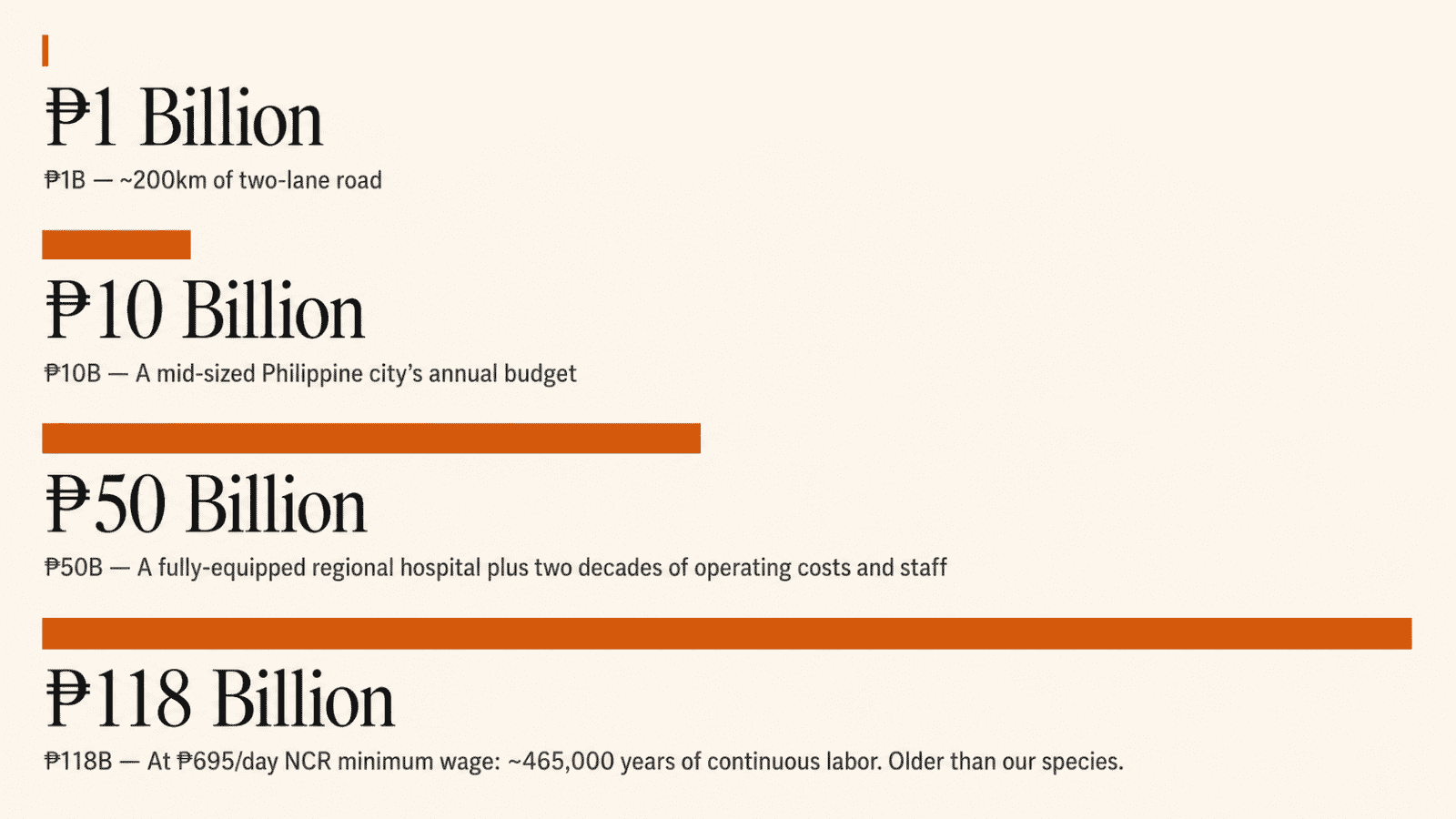
That last figure lands differently, doesn't it? Not because the number changed; it didn't. It's because the number was translated into something your brain can actually simulate. A person. A timeline. Something with texture.
Psychic numbing. The more lives that are at stake, the less each one moves us, and the same holds true for money, data, and infrastructure at scale.
— Paul Slovic, Decision Research
The Same Bug Shows Up in Technical Work
If you think this is only a political or social problem, consider how often it appears in your own domain.
Cost estimation creep
Studies on construction and infrastructure projects consistently show that engineers and project managers systematically underestimate costs. Not because of incompetence, but because of what's called the planning fallacy.
When you're projecting a ₱500M civil works project, the mental image you're working with is roughly the same resolution as a ₱5B one. The cognitive "feel" of both is just "large." The zeros beyond a certain threshold stop registering as distinct quantities.
Data at scale
Software engineers run into this constantly. One million database rows and one billion database rows are both described as "a lot of data" until your query brings a production server to its knees. A latency of 100ms and 1,000ms both sound like small, single-digit numbers until one of them makes your UI feel broken.
The compression effect doesn't just happen with money. It happens with any number that escapes the range our ancestors needed to survive.
Structural tolerances
In civil and structural engineering, the gap between a 1-in-100-year flood event and a 1-in-1,000-year flood event is numerically a factor of 10. Conceptually, both are described as "rare." Both feel improbable.
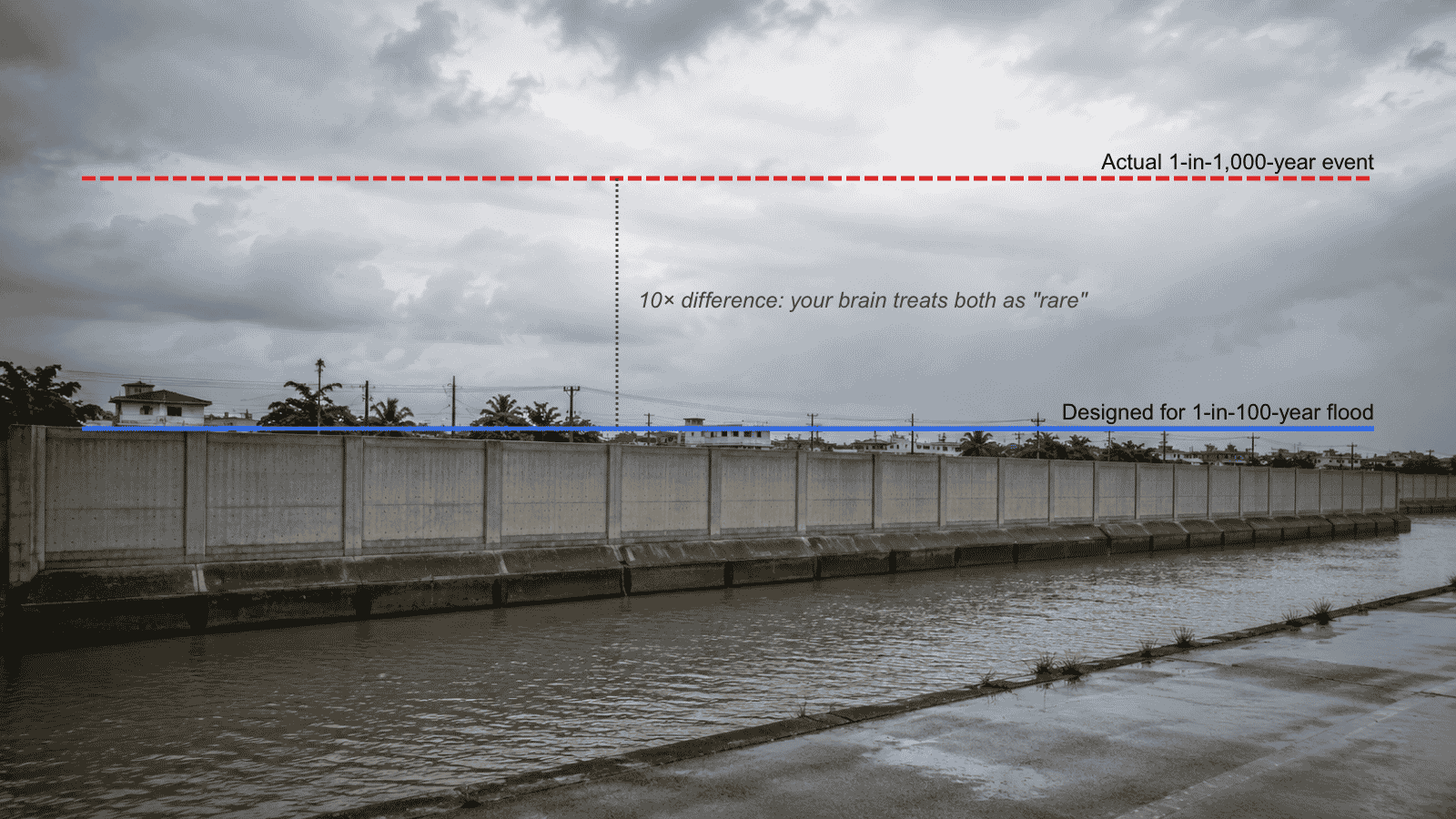
The brain treats them as belonging to the same emotional category: "unlikely things that happen to other people." But designing for one versus the other changes everything about your drainage channel, your retaining wall depth, your freeboard calculations. The cognitive blur between these numbers has real structural consequences.
Side note on scope insensitivity. In a well-known study, people were willing to donate nearly the same amount to save 2,000 birds as they were to save 200,000 birds. The quantity barely moved the needle, because the emotional image of "a bird covered in oil" was the same either way.
This isn't a quirk of charity psychology. It's the same mechanism that makes a ₱1B budget overrun feel equivalent to a ₱10B one.
Engineering Around a Cognitive Blind Spot
The field of risk communication has spent decades trying to solve exactly this problem. How do you get people, including technical decision-makers, to actually respond to differences in scale? A few frameworks have earned their keep.
Translate to time or labor, not money. Monetary figures collapse under compression. Time and human effort are harder to dismiss. Saying a project is "equivalent to 8,000 person-years of work" is harder to hand-wave than citing a figure in billions.
This is why good engineers and economists alike reach for analogies. Not because they're dumbing things down, but because analogies are how meaning survives the translation from abstract to comprehensible.
Use relative framing, but carefully. "This is 10× over the original estimate" is more legible than the absolute number because it provides a ratio. Ratios are exactly how our logarithmic brains compute scale natively.
The catch: ratios can also compress. "10×" sounds shocking until you've seen enough projects and every one of them is "N×" something.
Visualize the linear scale explicitly. Logarithmic graphs are extraordinarily useful for compressing data, but they systematically misrepresent differences to the untrained eye.
When communicating to non-specialists, or to yourself when making a decision, plot the linear axis. Let the gap look like what it is. The visual discomfort is informative.
Build numerical anchors into your mental model. Experienced engineers often develop personal reference points: "a kilometer of Metro Manila sewer rehab runs about ₱300M," "a good structural engineer costs roughly ₱X/month."
These anchors let them quickly feel when a number is anomalous. The same way a doctor knows that a resting heart rate of 200 bpm is wrong before they've run any tests. Calibrated intuition is built on a library of concrete reference quantities, not abstract familiarity with big numbers.
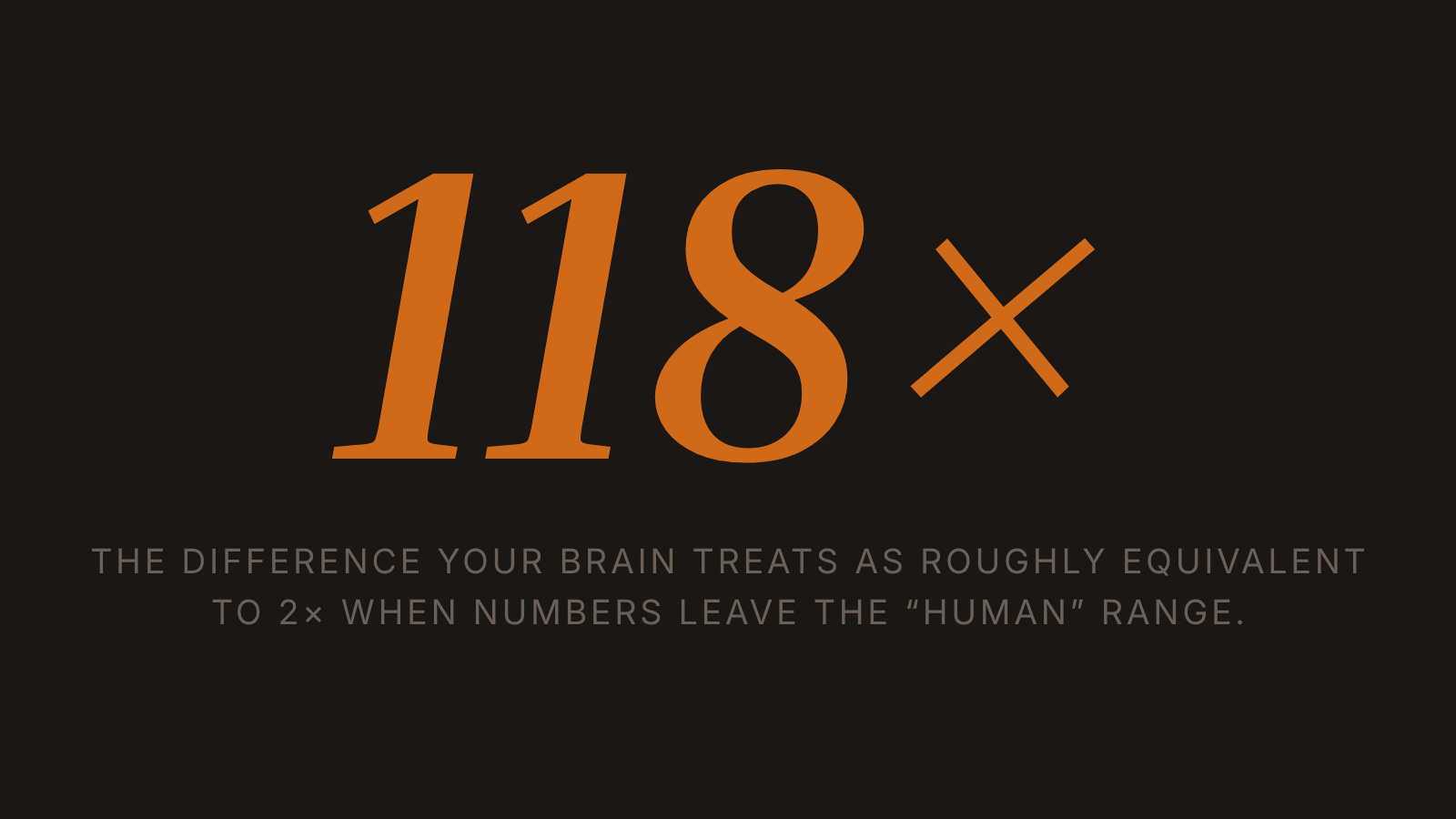
The uncomfortable truth is that the same cognitive machinery that makes corruption scandals feel abstract is the same one that leads to missed cost estimates, underdesigned drainage systems, and poorly communicated risk. The numbers are different. The blind spot is the same.
You can't rewire your logarithmic perception. It's not a flaw; it's what let our ancestors track animal populations without a spreadsheet. But you can build habits that compensate for it: ground abstract figures in human-scale equivalents, visualize linear differences explicitly, and stay suspicious whenever a very large and a very large-plus-something feel emotionally equivalent.
Because in engineering, that feeling of equivalence is often exactly where the error hides.